

Have you ever noticed that a Catholic wedding just feels different? A Catholic wedding is sacramental.
From the sacred rites and rituals to the reverent cadence of the day, even non-Catholic guests can sense that something holy is taking place. That feeling is not accidental. There is a very real reason a Catholic wedding day carries such depth and meaning.
For couples planning a Catholic wedding in Ohio, Indiana, Kentucky, or Michigan, understanding what makes marriage sacramental brings deeper purpose to the vows, the Mass, and the images preserved from the day.
Marriage as One of the Seven Sacraments of the Catholic Church
In the Catholic Church, marriage is not merely symbolic or traditional. It is one of the seven sacraments instituted by Christ.
The Baltimore Catechism defines a sacrament as:
“An outward sign instituted by God to give grace.”
On a wedding day, the Church is not simply witnessing love — she is witnessing the exchange of supernatural grace between a man and a woman who freely consent to give themselves fully to one another.
This is what makes a Catholic wedding fundamentally different from any other kind of ceremony.
The Outward Signs of a Sacramental Marriage
Sacraments engage the senses. They make the invisible grace of God visible through physical signs.
In Baptism, for example, those signs include water, oil, and a white garment.
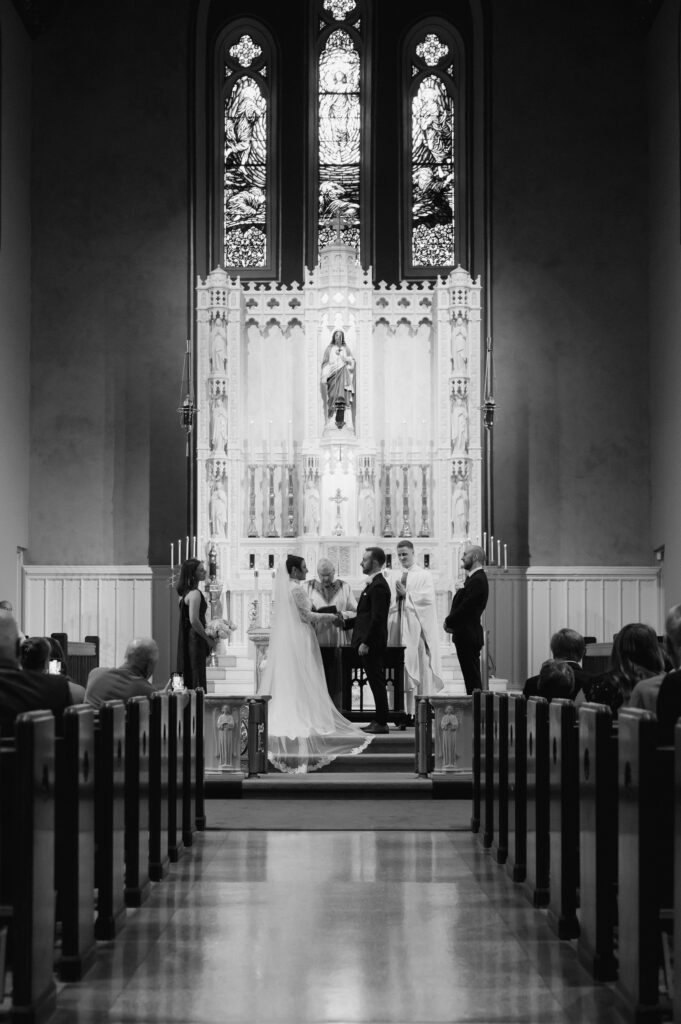
In Marriage, the outward signs include:
- The exchange of rings, often blessed with holy water
- The white wedding garment, traditionally symbolizing purity and self-gift
- The groom’s attire, historically reflecting sacrifice and responsibility
- And most importantly, the spoken vows
Unlike handwritten or personalized vows common in civil ceremonies, Catholic vows are sacred, traditional, and universal. The bride and groom confer the sacrament upon one another through their consent, witnessed by the Church and sealed by God.
The Biblical Foundation of Sacramental Marriage
For Catholics, marriage is not a modern invention or a social contract. It is rooted in Sacred Scripture.
- In Genesis, God declares that it is not good for man to be alone and creates woman as his suitable helper.
- In Matthew’s Gospel, Jesus affirms that what God has joined together, no one may separate.
- In Ephesians, marriage is revealed as a reflection of Christ’s love for His Church.
The Latin word sacramentum, used by St. Paul and later St. Jerome, confirms the true sacramental nature of marriage.
Christ Himself underscores this truth by performing His first public miracle at the Wedding Feast at Cana, revealing His presence within the marital covenant.
What the Catholic Church Teaches About Marriage
As For Your Marriage explains:
“When the Catholic Church teaches that marriage between two baptized persons is a sacrament, it is saying that the couple’s relationship expresses in a unique way the unbreakable bond of love between Christ and his people.”
Marriage, like the other six sacraments, reveals Christ and communicates His divine life and love.
Sacramental Marriage vs. Civil or Natural Marriage
In civil or non-Catholic weddings, rites and traditions are often optional. Couples choose their own wording, structure, and meaning.
While the Catholic Church acknowledges that natural marriages can be valid, they are not sacramental unless entered into according to canonical form between baptized persons.
The difference is profound:
- Civil marriage is a contract — an exchange of agreements.
- Sacramental marriage is a covenant — an exchange of grace.
Natural marriages can be dissolved through divorce. Sacramental marriages are supernatural and indissoluble, binding husband and wife together for life in the eyes of God.
The Grace and Beauty of Sacramental Marriage
Choosing sacramental marriage means inviting Christ directly into the center of your relationship.
Through this sacrament, couples receive:
- Grace to endure trials, sacrifices, and seasons of life
- Strength to love with selflessness and fidelity
- The supernatural help needed to remain faithful for a lifetime
- A deeper understanding of fruitfulness, including openness to children
- Participation in co-creation with God
Statistically and spiritually, sacramental marriages endure because couples are not relying solely on themselves. There is always a store of grace available in moments of hardship.
The goal of sacramental marriage is clear and eternal: to help one another get to heaven.

Why the Church Requires Marriage Preparation
If sacramental marriage feels like a serious commitment, that is because it is.
The Church requires marriage preparation and pastoral guidance not to burden couples, but to protect them. This preparation equips husbands and wives to enter fully into the mystery they are receiving.
The Church also provides lifelong support, formation, and encouragement so married couples continue growing together toward eternity.
A Sacred Union Worthy of Reverence
Sacramental marriage is one of the greatest gifts God has given humanity.
It is total.
It is faithful.
It is fruitful.
And it is part of Christ’s divine plan for the salvation of the world.
For couples planning a Catholic wedding in Ohio or throughout the Midwest, this sacred understanding gives meaning not only to the vows you speak — but to every image, moment, and memory preserved from your wedding day.

